

Breath holding is extremely common in young children and can happen as often as once a day. Often referred to as a spell, it involves your child (usually aged 6 months to 6 years) holding their breath when they're upset, frightened, hurt or had a minor accident. They will cry, catch their breath, then "hold it" without breathing. It's not something they do on purpose, more of a reaction and it typically only lasts 30-60 seconds.
Breath Holding Spells
Breath holding can be alarming and stressful to parents and anyone involved, but don't panic; this spell is not harmful to your child and it'll pass quickly. Try to remain calm and do not shake or force your child to breath; the spell will pass and they will continue to breathe regularly on their own in a matter of seconds.
Causes
Doctors still aren't sure of the exact cause of breath-holding. It's thought to be caused by slowing of the heart rate or changes in breathing patterns. It's also thought that they can be triggered by strong emotions, like anger, pain + fear, but there is also a genetic link with a third of kiddos who breath-hold having a family history of it. Interestingly, it's also thought that little ones who do this are more likely to faint as a teen and adult.
Blue Spells and Pale Spells
There are two main types of breath holding that can occur in your child; blue or pale spells. While both only last a few seconds, they do have some main differences as outlined below:
Blue Spells
Blue spells, or cyanotic breath holding, are the most common. Although uncomfortable to watch, blue spells do not require any treatment and no long-term damage is done. They can happen when your child has hurt themselves or has become upset or frightened and can be characterised as:
- Crying or screaming: your child will be visibly distressed
- Forcibly breathing: they may breathe out hard before holding their breath
- Skin colour change: can turn a pale blue colour (usually around their mouth)
- In extreme cases: can lead to fainting
Pale Spells
Pale or pallid spells are less common than blue spells and are caused by a slow heart rate. No treatment is needed for a pale spell and your child will resume normal breathing in seconds. These spells can be characterised as:
- Opening of the mouth: as if they're going to cry but nothing comes out
- Pale or faint looking: with jerky arm/leg movements and possibly loss of control with their bowels
- Sweating and tired: when the spell passes
Staying calm is the most important thing you can do for your little one during a breath holding spell.
This can be a frightening time but it will pass quickly! A few things you can do during a breath holding spell are:
- Stay calm! This will pass soon
- Lay your child comfortably on their side for the remainder of the spell
- Don't shake your baby, this will not promote breathing
- Reassure others around you what is happening, how it will pass soon and it is not harmful to your child
- After a spell, your child may be drowsy and seem disoriented; this is normal. There also may be some residual muscle twitching, although uncommon. Once they've recovered, reassure them that everything is okay and act normally. Don't make a fuss or punish them.
When to See a Doctor
Remember, breath holding is very common in young children and not harmful. Although distressing to watch, it will be over in a matter of seconds! If you notice your child having frequent spells (multiple in a day) or has a fit lasting longer than a few minutes, consult your doctor. It's also time to take your kiddo to see a doctor if:
- Frequency: they are having very frequent spells [more than once a day or a few times a week]
- First time: it is the first time this has happened
- Seizure: your little one has a seizure after it
- Unusual behaviour: your little one is acting unusually after the spell
- Red flags: you notice any other red flag symptoms
- Concern: you're concerned
BRUE
Another term that you may hear as a parent and is very similar is a BRUE.
What is a BRUE?
BRUE stands for
- B: brief
- R: resolved
- U: unexplained
- E: event
BRUE occurs suddenly and can be really scary for parents. The diagnosis of BRUE is made after all possible causes have been excluded and it's determined that there was no known concerning cause for the BRUE occurring.
Signs + symptoms of a BRUE:
In a BRUE, you will notice 1 or more of the following:
- Changes to breathing: decreased, irregular or absent
- Changes to skin colour: pale or blue
- Changes to conscious state: drowsiness or unconscious
- Changes to muscle tone: tight or floppy
What to do?
The answer to that depends on whether BRUE is diagnosed or not. If your little one isn't diagnosed, you need to treat the signs of altered conscious state, breathing problems, skin colour changes and muscle tone changes as an emergency and start DRSABCD as soon as you recognise these changes.
If it really is a BRUE, you will only reach 'airway' before your child returns to a normal conscious state. You should keep an ambulance on the way, stay with your little one + continue to monitor them. Without an official diagnosis of BRUE, you need to treat this situation as an emergency with an unknown cause. The reason for this is that if your little one doesn't return to a normal state, you could have lost precious minutes - so treat it as an emergency until you know otherwise.
Other things your Doctor/ the hospital will try to rule out include:
- Heart + lung disorders
- Metabolic + immune disorders
- Tummy disorders
- Infections
- Viruses Poisoning
Once diagnosed, you'll know how long the episodes last, and you'll be able to closely monitor + begin first aid should the episode differ from what normally happens when your little one has a BRUE. If it's a normal BRUE, you can manage at home + follow the plan provided by the doctor who diagnosed your little one as having had a BRUE.

Newborn Breathing
It's important to know that newborns don't have breath-holding episodes. But they are irregular [or periodic] breathers. Babies breathe a lot faster than we do [about 30-60 breathes a minute], and also quite a bit differently. They are big-time nose breathers, and their still-developing lungs and little airways mean they will often take brief pauses between breaths. This can be alarming to observe, but rest assured, it's normal. Although it's more likely in premmie babies, even healthy, full-term bubs up to 6 months of age will have episodes of what we call 'Periodic Breathing.' This is when your little one's breaths pause for less than 10 seconds and then restart, often with several rapid breathes before it returns to normal. These irregular breathing patterns are common when bub is sleeping and in most cases, a part of normal development that they will grow out of as they age.
Periodic breathing is not the same as an apnoea or BRUE, and won't result in a change to your bub's skin colour. If bub is having an apnoea, it's important to perform DRSABCD + seek medical attention. Apnoeas in little ones can be caused by various things, some of which include Whooping Cough + infection, which is why it's important to get bub checked if they are very young and are experiencing breath-holding episodes.
Breathing Monitors
We often get messages from parents asking about breathing monitors, particularly when it comes to sleeping. These are some breathing monitors I know of:
Owlet
A sock-style monitor that wraps onto bub's foot and monitors heart rate, oxygen saturation and if they're in a light or deep sleep. The device will alarm if bub goes outside of the preset ranges for both heart rate and oxygen saturation to wake you into action. If you have wifi, you can connect it to your device to see live readings. However, it's not cheap, and I don't like that you can't customise its "normal" ranges.
Snuza
A monitor that uses motion detection by clipping onto bub's nappy to count breaths per minute, skin temperature and sleeping position. It also alerts if bub stops breathing after 15 seconds, then alarms at 20 seconds. It can send live readings to your device using Bluetooth, and you can change the "normal" ranges of breaths. With this, there can be false alarms if it slips off bub's nappy, and it's not cheap either.
Breathing pads These work on motion detection under bub's mattress and alert if breathing movement slows to <10 breaths/ minute or isn't detected for 20 secs. If bub wriggles off, it may sound a false alarm or may falsely detect breathing from an overhead fan.
It's important for any parents considering this to know that Red Nose tells us that currently, there's no research saying a breathing monitor will prevent SIDS. These devices don't save your bub's life if they stop breathing; they simply alert you to it. If it ever happened, you would still need to provide CPR until the ambulance arrived. So ask yourself, am I buying this to be alerted or am I buying this to save my bub's life?
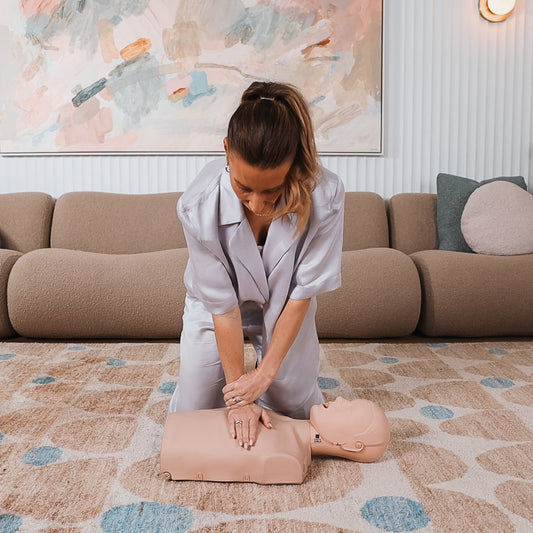
If it's the latter, the device simply doesn't do that; but you can. Our Baby First Aid course will give you the skills I hope you never need to use to step up + save your precious Tiny Heart.

Watching your little one have a breath-holding spell is terrifying but knowing what to do in any emergency can make all the difference. Our Baby & Child First Aid Course will give you the confidence and skills to stay calm and act fast when it matters most.