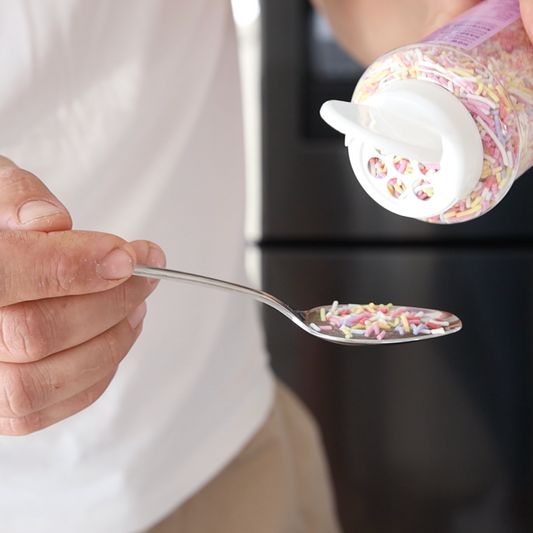

You turn your back for thirty seconds and your little one has popped a sultana, a bead or a tiny piece of Lego straight up their nose. It happens more often than you'd think, and it almost always happens to toddlers, because exploring the world with their fingers (and their nostrils) is literally their job.
Before you reach for the tweezers or bundle everyone into the car, there's a simple technique you can try at home first. It's called the Big Kiss. You might also know it as the Mother's Kiss, and it's been used by doctors and paramedics for decades. Done correctly, it's safe, it's gentle, and it works about 60% of the time.
Here's exactly how to do it, when to use it, and when to skip it and head straight for help.
What is the Big Kiss?
The Big Kiss is a first aid technique for removing an object stuck in a child's nostril. You seal your mouth over your little one's open mouth, block their clear nostril with your finger, and give one short, sharp puff of air. The puff travels up through the back of the nose and pushes the object out of the blocked nostril, a bit like blowing their nose for them.
It was first described by a GP back in 1965 and has been part of medical practice ever since. Emergency departments and GPs still use it today as a first-line option, because it can spare a distressed toddler from being held down while a doctor goes in with instruments, and in some cases it avoids the need for sedation or a general anaesthetic altogether.
It's traditionally called the Mother's Kiss, but any trusted adult can do it. Dads, grandparents and carers included. That's why we renamed it the Big Kiss.

How to do the Big Kiss, step by step
1. Stay calm
Your little one takes their cues from you. If you panic, they panic, and a crying, sniffing child can pull the object further in. Keep your voice light. You can even frame it as a game: "I'm going to give you a big kiss!"
2. Sit them up
Have your little one sit upright. Don't lie them down, because gravity is on your side when they're sitting up.
3. Block the clear nostril
Press your finger gently over the nostril that doesn't have the object in it, so the puff of air has only one way out.
4. Seal your mouth over theirs
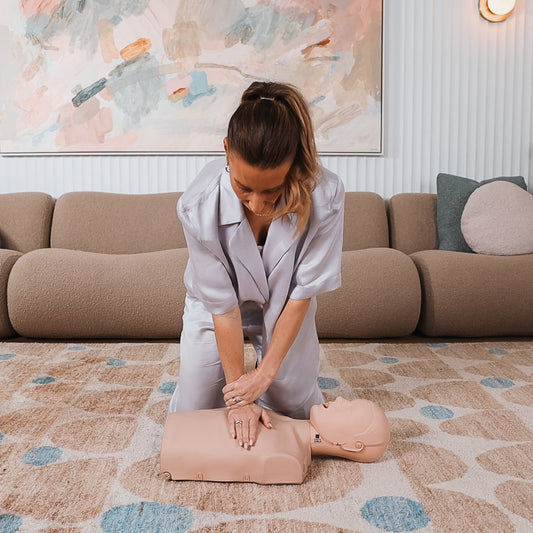
Place your mouth completely over your child's open mouth, forming a firm seal, just like you would for rescue breaths.
5. Give one short, sharp puff
Blow gently into their mouth until you feel a slight resistance, then give a short, sharp puff. That resistance is their throat closing off naturally, which sends the air up and out through the nose instead of into the lungs. The object should shoot out of the blocked nostril.
If it doesn't come out on the first go, you can repeat the technique a few times. If it's still not budging, it's time to have it removed by a doctor.
The puff should be short and sharp, about the force of a sneeze. Never a long, sustained blow.
One technique is never enough
Things up noses, choking scares, bumps and burns. Little ones keep you on your toes, and the moment always arrives before the training does. Our Baby & Child First Aid Course, designed by former paramedic Nikki Jurcutz, gives you the whole toolkit, because in an emergency your brain falls to the level of your training.
★★★★★ 4.9 from 3,500+ parents

“As a new parent it has not only given me the knowledge of what to do in different situations, but also the confidence to act.”
Marissa · Tiny Hearts parent
Does it actually work?
Yes. A review of the evidence found the technique successfully removed the object in around 60% of cases, and it worked on both smooth and irregularly shaped objects. No serious complications have ever been reported in the medical literature.
There are some theoretical risks, like ear or lung injury from the puff of air, but no cases of eardrum rupture or lung collapse have been recorded. That's because the pressure from a short, sharp puff is roughly the same as a sneeze.
And even when the Big Kiss doesn't fully remove the object, it often moves it closer to the front of the nostril, which makes it easier for a doctor to remove without sedation.
What NOT to do
👉 Don't go in with tweezers, cotton buds or your fingers, because you're far more likely to push the object deeper than pull it out
👉 Don't ask your little one to sniff or breathe in through their nose, because inhaling can pull the object further back towards the airway
👉 Don't ask a young child to blow their nose forcefully while distressed, because a big inward breath beforehand can do the same thing
👉 Don't hold off on getting help if it won't come out, because objects left in the nose can cause infection
While the object is in there, encourage your little one to breathe through their mouth.
When to skip the Big Kiss and get help
Head to your GP or ED without attempting the Big Kiss if:
- Your little one is having any difficulty breathing
- There's bleeding from the nose that won't settle
- You can't see the object, or you're not sure anything is actually in there
- The object has been in the nose for more than a day (a smelly, one-sided discharge is a classic sign)
- Your child won't stay calm enough for you to do it safely
And if your little one is ever struggling to breathe or turning blue, call 000 straight away.
A warning about button batteries
If the object up your little one's nose is a button battery, do not wait and do not try the Big Kiss first. Call the Poisons Information Centre on 13 11 26 immediately and follow their advice, because button batteries react with the moisture inside the nose and can burn through tissue within hours. A button battery anywhere in a child's body is a medical emergency and warrants urgent removal.
The same urgency applies to magnets and anything sharp.
FAQs About the Big Kiss
Is the Big Kiss the same as the Mother's Kiss?
Yes. The Big Kiss is the same technique as the Mother's Kiss, sometimes also called the Parent's Kiss. We use the name Big Kiss because it isn't just for mums. Any trusted adult can perform it.
What age can you do the Big Kiss on?
It's best suited to babies and young children, and it's most commonly used on the one to eight age group, because they're the ones most likely to put something up their nose and least likely to blow it out on request. Older children can often clear the object themselves by blocking the clear nostril and blowing out hard.
How hard should I blow?
Blow gently until you feel resistance, then give one short, sharp puff, about the force of a sneeze. Never give a long, sustained blow.
Can the Big Kiss push the object further in?
No. The air travels from the mouth up behind the object, so the pressure pushes it out of the nostril, not deeper in. The things that push objects deeper are tweezers, fingers and sniffing.
What happens if the object doesn't come out?
Repeat the technique a few times. If it still won't budge, see your GP or head to ED the same day, because objects left in the nose can cause infection and become harder to remove.
Be ready for the next one, whatever it turns out to be. Let us teach you →
Sources: RACGP — Mother's kiss for nasal foreign bodies | Cleveland Clinic — Try a Mother's Kiss